
We Spent 2025 Teaching AI to Ride Shotgun
In January I wrote here that AI had finally stopped being a pilot program — that carriers had moved from "we're running a lab project" to "how do we stop doing this manually." Six months later I want to make a sharper claim, because the ground has already moved again.
What went into production in 2025 was mostly copilots. An adjuster opens a claim and an AI hands them a summary of 800 pages of medical records. An underwriter pulls up a submission and a model flags the three things worth a second look. The human is still doing the job; the AI is riding shotgun. That was the right first step, and it worked.
But a copilot waits to be asked. The thing arriving now doesn't wait. It's called an agent, and that distinction is the whole story.
What "Agent" Actually Means — in Insurance Terms
Strip away the hype and an AI agent is software that can take a goal, break it into steps, use tools, and carry the work across those steps without a human driving each one. A copilot answers a question. An agent completes a task.
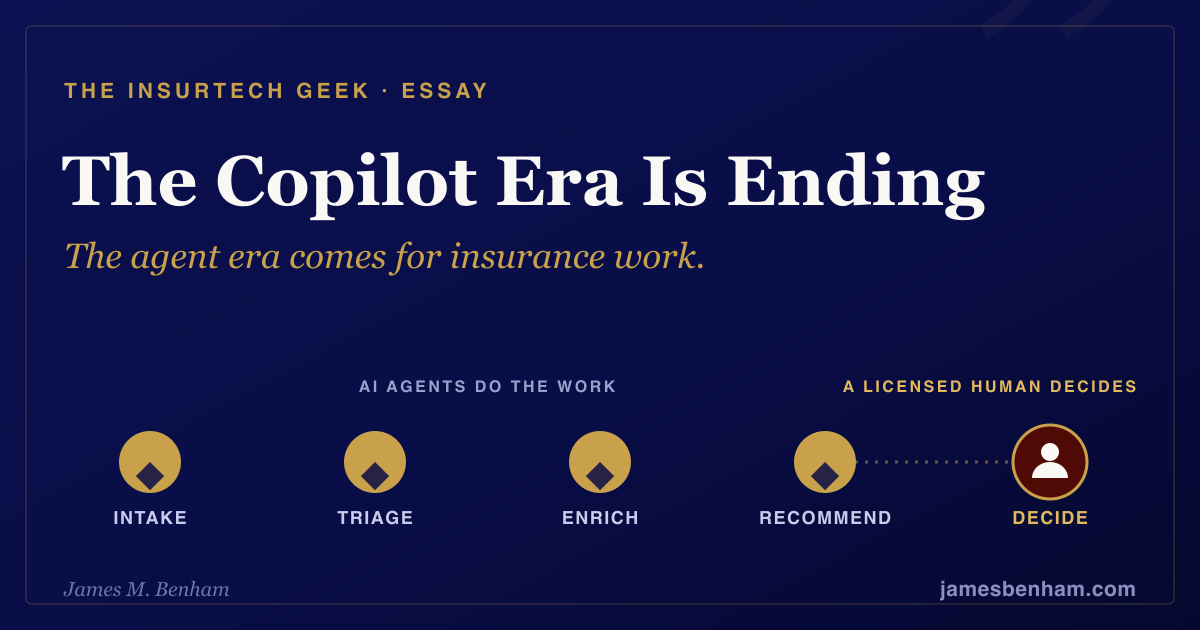
Put that in a submission pipeline and it stops being abstract. A commercial submission arrives as a messy email with a 40-page loss run attached. Yesterday's copilot could summarize the loss run if an underwriter asked it to. An agent takes the whole submission: it reads the email, extracts the data, pulls the loss history into structured fields, enriches it against third-party sources, checks it against appetite, and hands the underwriter a clean, priced-out recommendation with its reasoning attached. Intake, triage, enrichment, recommendation — four steps that used to be four people and three days, done before the underwriter has finished their coffee.
Same shape in claims. First notice of loss comes in. The agent classifies it, confirms coverage, orders the records, summarizes them, flags the fraud signals, drafts a reserve recommendation, and routes it. The adjuster opens a file that has already been worked.
That's the exact shape Terra, the claims platform I co-founded, is built around: the agent does the preparation, a licensed adjuster makes the call.
The Demo That Will Lie to You
Here's where I need to be the operator in the room instead of the guy on the stage.
Every one of those workflows has a version where the agent doesn't hand anything to anyone — it just decides. Binds the policy. Approves the claim. Pays it. The demos are extraordinary, and the temptation to close the loop and let the machine finish the job is going to be enormous, because that last human step is exactly where the cost and the latency live.
The demo always ends with the AI making the decision. The business always ends with a licensed human who has to answer for it. Insurance lives in the gap between those two facts. — James Benham
That gap is not a technology problem you can wait out. It's the structure of the industry.
Software Still Doesn't Repeal the Laws of Underwriting
This is the through-line of everything I put in Geek Out, and it applies to agents even more than it applied to the last wave. A binding decision, a coverage determination, a claim denial — these sit inside a regulated system that requires a licensed, accountable human, that gets audited by a state department of insurance, and that has to hold up in front of a jury. "The agent decided to deny it" is not a defense. The carrier still owns the outcome.
The venture-funded insurtech wave learned this the hard way. Software was going to disintermediate the agent, replace the carrier, own the customer. It mostly didn't — because a slicker interface doesn't repeal the capital requirements, the licensure, or the regulatory accountability underneath it. Agentic AI is far more powerful than anything that wave had. It also runs into the exact same wall, just further down the workflow.
Supervised Agents, Not Autonomous Ones
So the winning pattern isn't "autonomous." It's supervised. Let the agent do all four steps of the work — intake, triage, enrichment, recommendation — at machine speed and machine scale, and keep the licensed human on the decision. Not because the human re-reads all 800 pages; they don't. Because the human is the accountable party the entire system is built around, and the agent's job is to make that person faster and sharper, not to vacate the seat.
If that sounds familiar, it's the same lesson from the last cycle, one workflow deeper. The insurtechs that survived didn't try to replace the agent channel — they augmented it. The AI that wins won't try to replace the underwriter or the adjuster. It will do everything up to the decision and hand over a case so well-prepared that the decision takes thirty seconds instead of three days.
The Operator's Job Just Changed
This is where Be Your Own VC shows up, because deploying agents well is a discipline problem before it's a technology problem.
When anyone on your team can spin up an agent that touches real policies and real claims, capability stops being the constraint — governance becomes it. Which workflows are you willing to let an agent run end to end? Where exactly is the human checkpoint, and is it a real review or a rubber stamp? What does the agent log, so that when a regulator asks "why did you price it this way," your answer isn't "the model felt like it"? Who owns the outcome when the agent is wrong — and it will be wrong sometimes?
The carriers that get this right in 2026 won't be the ones who deployed the most agents. They'll be the ones who were deliberate about where the agent stops and the human starts — who treated autonomy as something you grant one workflow at a time, earned with evidence, not switched on because the demo was impressive. That's capital discipline pointed at a new kind of spend. Build what you have to so you can build what you want to.
What I'd Tell a CIO This Quarter
Pick one workflow. Submission intake or FNOL triage — something high-volume, painful, and reversible. Put an agent on the whole chain up to the decision. Keep a licensed human on the decision itself, and instrument everything so you can prove what happened. Get it into production, measure the cycle-time drop, and learn what breaks. Then do the next one.
Don't wait for the fully autonomous version. For your regulated workflows it's either not coming or coming far slower than the keynote circuit implies — and while you wait for it, you cede the compounding advantage of faster cycles, faster learning, and better models to the carrier down the street who started supervising agents this quarter.
The copilot taught the industry that AI could sit in the seat next to the expert. The agent is going to make the whole drive up to the destination. But in insurance, someone licensed still has to decide where you're going — and be able to explain, under oath, why. That hasn't changed in seven years and 178 episodes. I don't think it changes by 2030 either. Almost everything else is about to.